
Healing Power of Art
Variety of form and brilliancy of color in the object presented to patients are an actual means of recovery.
Have you ever taught your children not to talk to strangers? Have you ever reminded them to never allow a stranger to touch them? I have.
A few summers ago while visiting my daughter and her husband, we took a day trip to New Orleans. As we started on our self-guided walking tour throughout the French Quarter, I reminded my son, John, a 13-year old, to stick close. And I held the hand of my 10-year-old son, Nate.
After wandering around for a couple of hours, I relaxed my grip and let go of Nate’s hand. He stayed near me. Since it was getting late, we decided to head back towards our car. As we headed up Royal Street, the street musicians were spilling out onto the sidewalks and streets.
In front of us, we saw a strange sight. A woman wheeled her piano out into the middle of the street. We stopped, hoping to listen to some music. But she started talking with other musicians. So we kept walking.
In front of us on the next block beyond the St Louis Cathedral, an old musician bent down in the middle of the sidewalk, opening his trombone case. As we tried to slip past him, he stood up and with a raspy voice asked, “Does anyone have a camera?”
None of us answered him although I did have a camera. So he asked again, “Does anyone have a camera?” Again, no one spoke up.
Nonchalantly, the old musician sat down on a small stack of milk crates. Then he directed his next question to Nate. “Would you like to play the trombone?” Like his mother, Nate didn’t answer. But the old musician smiled and motioned for Nate to come over to him.
Nate glanced at me, and I half nodded. So he took a few steps forward. But before I could react, the old musician clasped his big brawny hand around Nate’s little hand, drawing it up to the trombone. Nate’s body stiffened.
Looking around at us, the old musician asked, “What kind of music do you like?” Once again, no one responded. Unruffled by our lack of cooperation, the musician continued his one-way conversation. “Blues? Gospel music?”
My son-in-law finally broke the silence, “Gospel music.”
With that response, the old musician smiled again. Then he turned to Nate, saying, “Ready?”
Nate moved his head slightly up and down. But the rest of his body remained stiff. As the slide moved back and forth, the old musician began to play “When the Saints Come Marching In,” pulling Nate into the music.
At first, I stood there shocked that the homeless stranger was touching my son. But as I listened, the gospel music began to melt my apprehensions. Suddenly, I caught a hint of a future painting—the old musician and the young boy—emerging onto the canvas right there in front of me. So I pulled out my camera and snapped a picture.
At the conclusion of the song, we all clapped. Thanking the musician, I tossed some money into the trombone case. Then I took Nate’s hand, and we left.
The following week after returning home, I downloaded the picture onto my computer. Feeling a bit anxious, I wondered if I had caught the Kodak moment. As the picture popped up onto the screen, I smiled. There was the old musician with his large brown-eyes and my son. Success.
A few days later after I started the painting, I asked an artist friend, to critique my artwork. Instantly, she pointed out that the camera’s eye had peered down on the old musician and the child. Thus the angle distorted the subject matter, making their heads appear larger and their feet, very tiny.
Usually, when photographing children, I kneel to get on their level. But since I had been so distracted by the homeless person, I remained standing. So my vantage point distorted the figures.
After considering my friend’s advice, I started a second painting. This time I focused on the old musician and the boy from the waist up. The new perspective created a stronger composition and emphasized the focal point: the old musician’s hand skillfully guiding the young boy’s.
Amazingly, in the end, my perspective towards the stranger had changed. And I even found myself grateful that he had touched my son. The old musician on Royal Street had taught me a lesson: don’t allow limited perceptions to distort our view of others.
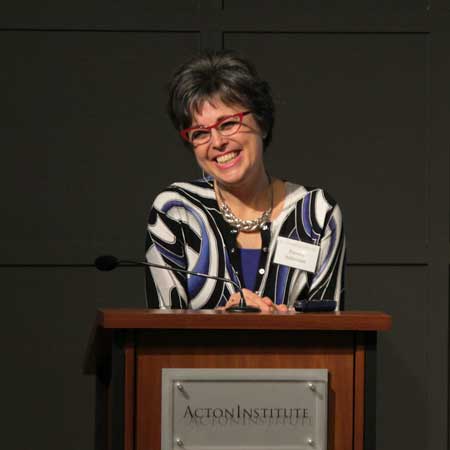
American portrait artist Pamela Alderman creates memorable life portraits. She crafts commissioned paintings of children—playing on the beach or building a snowman—that come to life on the canvas and tell a story.
Pamela’s portrait paintings make unique gifts for occasions like Mother’s Day, Grandparent’s Day, or a special birthday. For 2010, Pamela will accept a limited number of commissions. If you are interested in having a watercolor portrait painted, please contact Pamela to inquire about the opportunity.
In early 2010, Rady Children’s Hospital of San Diego added Pamela’s painting, entitled Discovery, to their permanent collection.
by Pamela Alderman
Original watercolor on paper
Art offers the power to pause and the potential to find healing in the remembrance of things past.
Pamela’s painting, entitled “Purple Iris,” was selected for the 24th annual West Michigan Regional competition.
Come join Pamela for the artist reception at the Lowell Area Arts Council on Sunday, March 14, 2010 from 2:00-4:00 p.m.
The exhibition runs from:
Thursday, February 18, through Friday, April 9, 2010.
Gallery hours:
Tues-Fri 12:00-6:00 p.m.
Sat 1:00-4:00 p.m.
Telephone: 616-897-8545
For directions, please visit the Lowell Area Arts Council web site.
A young woman named Katie (not her real name) knocked on my door, selling children’s books. She intrigued me. Something seemed to be missing in her life. No matter what I asked her, she responded with the same rehearsed script.
After inviting her into my home and looking at the books, I noticed one was about God. I asked, “Katie, do you know God?” She responded vaguely.
At that point in the conversation, I started to share my story of how I discovered hope in the midst of my parent’s divorce. But she interrupted me, “My parents are divorced too.” Then she quickly changed the subject back to books.
I decided to buy some books, hoping that this would give me another chance to talk with her. She told me that she would return in August to deliver them.
In August, she returned with the books. When I asked her about her day, she began crying. A stressful day caused her to leave her rehearsed script. Finally, my opportunity arrived.
While sitting at my kitchen table, I asked Katie if I could draw out an illustration of my story. She said, “Okay.”
Flipping over scrap paper, I drew a stick figure representing me on the left. I wrote God’s name on the far right. I told her that the wide gap in the middle represented my unwillingness to allow God to control my life, which separated me from Him.
“Katie,” I said, “the Bible tells us, ‘for all have sinned and fall short of the glory of God.’ 1 The word sinned in the Bible defines all my mistakes and failures. Instead of going God’s way, I want to be in charge.”
I continued, “The Bible also says, ‘But God demonstrates his own love for us in this: While we were still sinners, Christ died for us.’ 2 Jesus reconciled me to God by dying on the cross and rising from the dead.”
On my diagram, I added a cross connecting the stick figures that represented God and me. And I wrote the name Jesus above the cross. Between God and me, Jesus was the only bridge of hope.
Lastly I said, “The Bible promised that ‘Yet to all who received him, to those who believed in his name, he gave the right to become children of God.’ 3 This relationship starts when we invite Him into our lives.” Sensing her openness, I asked, “Katie, would you be willing to place an ‘X’ where you see yourself in this illustration?”
She said, “Okay.” And she drew her “X” just barely on the left hand edge of the cross.
Then I asked, “Where would you like to be?”
She said, “On the right hand side.” She wanted to put her name next to God’s. I told Katie that she could enter into a relationship with Jesus by simply talking to Him.
“Katie,” I asked, “Are you ready to invite Jesus into your life?”
She responded, “Sure.”
So in my kitchen, Katie, my two young sons, and I stood in a circle and joined hands. Then Katie invited Jesus into her life. She prayed, “Jesus, I’m sorry for all my mistakes and failures. Please come into my life.”
After her prayer, I told Katie that she now belonged to Jesus. Katie no longer had to wander aimlessly. The girl who had meandered to my door selling books now left with hope.
Every artist dips his brush in his own soul, and paints his own nature into his pictures.
The Celebration of the Arts in Grand Rapids selected my painting, entitled Stillness, for the 37th Annual Juried Spiritual Arts Competition.
Come join us for the Artists’ Reception on Friday, February 5 from 7-9 p.m.
The show runs from Saturday, February 6 through Tuesday, February 16. Gallery hours are from 10 a.m.-6 p.m. (Ash Wednesday, February 17 from 10 a.m.-4 p.m.)
Location:
First United Methodist Church
227 East Fulton
Grand Rapids, MI 49503
Phone: 616.451.2879
I paint because I must. At times while driving, I’m so captivated by the lighting or cloud formations that I reach for my camera, open the car window, and start snapping pictures (not recommended for safety).
During scheduled sabbaticals from painting, I catch myself still creating mental paintings. Or, like an overstuffed attic, I cram my mind with future paintings. Last summer, one of our dinner guest exclaimed, “Pamela, creativity is pouring out of your pores.”
Sometimes I have to force myself to put my brush down. Otherwise I bargain, Just one more stroke. And before I know it, an hour or two has passed.
But when the last brush stroke is applied to the canvas, I can finally relax. Satisfied, I know that I have endeavored to create something beautiful to uplift the heart. And I feel pleasure.
Photographs waiting for the next burst of creativity cover the floor in my art studio. Every time I walk into my studio I sense the photos beckoning me. As I stare at the pictures, I start working out the next painting’s details: the colors, the lighting, and the background. Although household duties vie for my attention, I find that I must paint some more.